Skip to content
Kappa Wealth Systems

Wealth Studio Lab

Financial planning is easier to understand when you can change the assumptions.

Wealth Studio Lab uses representative households to explore how markets, taxes, goals and financial decisions interact inside a connected planning model.

Stress Test 001

One Household. Three Stress Tests. Very Different Futures.

Start with the same household and the same baseline plan. Then change the environment around it. Wealth Studio Lab examines how different market sequences can expose different risks, trade-offs and planning questions.

Baseline

Baseline

Wealth StudioLab · Baseline
Wealth Studio Lab baseline plan

Analysis

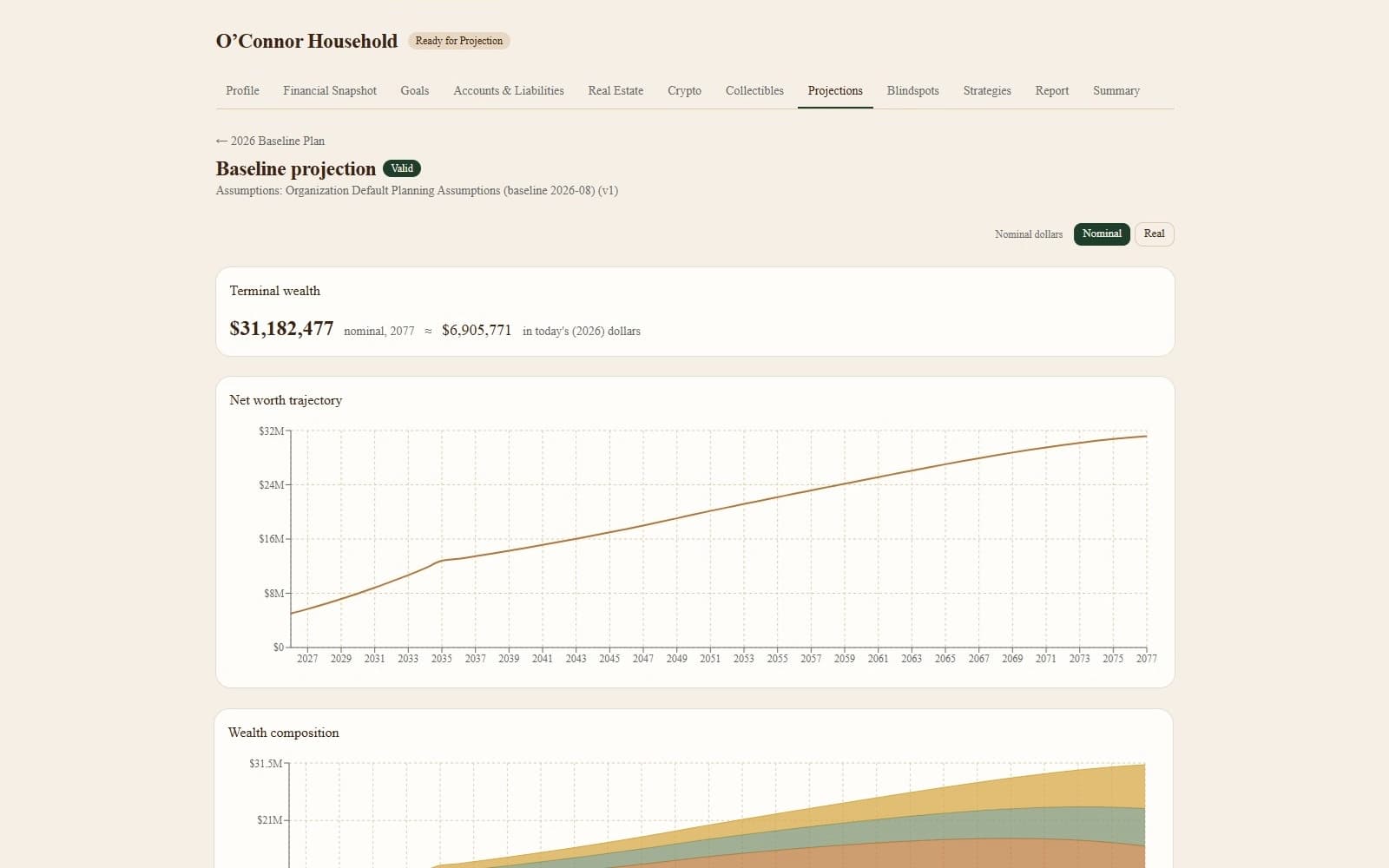
Under the baseline planning assumptions, the household reaches approximately $31.2M in terminal wealth ($6.9M in 2026 dollars) with no modeled spending shortfall. This establishes the reference trajectory against which the stress scenarios can be evaluated; it is a planning baseline, not a forecast of future returns.

Scenario 1

Stagflation Sequence

Wealth StudioLab · Stagflation Sequence
Wealth Studio Lab stagflation sequence

Analysis

The five-year stagflation sequence materially changes the plan. Terminal wealth falls from $31.2M to $15.0M, modeled spending shortfalls begin in 2053, and cumulative shortfalls reach approximately $24.0M. The combination of substantial terminal wealth and spending shortfalls also signals an important planning question: whether wealth exists in the right form, at the right time, to support household cash-flow needs.

Scenario 2

Historical Extremes

Wealth StudioLab · Historical Extremes
Wealth Studio Lab historical extremes

Analysis

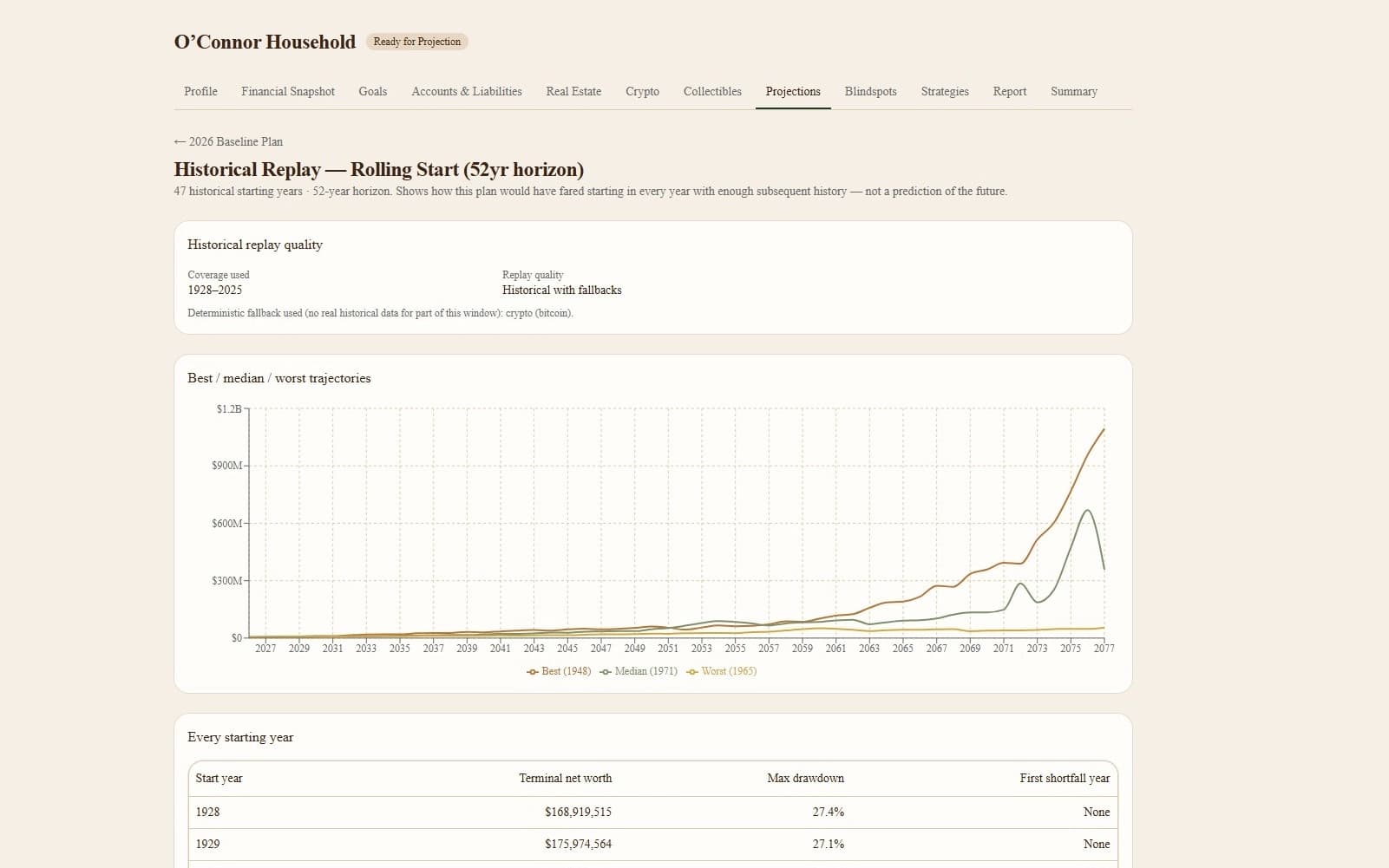
Across 47 historical starting years, the same household plan produces dramatically different long-term trajectories. The best, median and worst sequences begin in 1948, 1971 and 1965, respectively, illustrating how strongly the ordering of market returns can influence long-horizon outcomes. Historical replay does not predict which path lies ahead; it reveals how sensitive the plan is to sequences that have actually occurred.

Scenario 3

2008 Financial Crisis Replay

Wealth StudioLab · 2008 Replay
Wealth Studio Lab 2008 financial crisis replay

Analysis

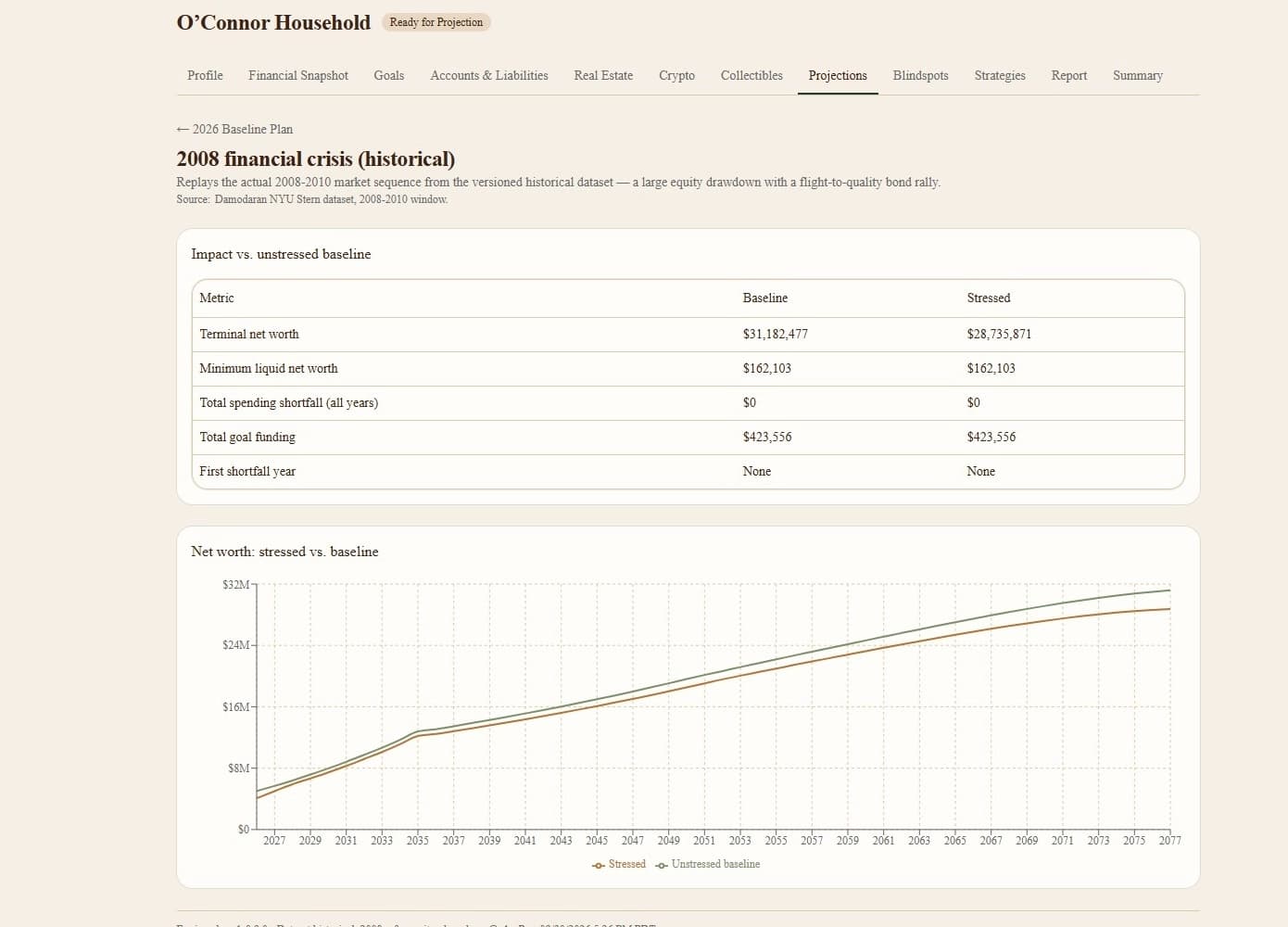
Replaying the 2008–2010 financial-crisis sequence reduces terminal wealth from approximately $31.2M to $28.7M, but the modeled plan still shows no spending shortfall and no reduction in goal funding. In this case, a severe historical market shock affects long-term wealth without causing the household's modeled plan to fail.

Illustrative scenarios using representative household data. Historical scenarios do not predict future results. Content is for informational and educational purposes and is not investment advice.

In preparation

Planned Lab experiments

  • Planned Lab

    Withdrawal Sequencing

    How might different withdrawal strategies affect taxes and long-term outcomes?

  • Planned Lab

    Competing Goals

    What happens when individually achievable goals compete for the same household capital?

  • Planned Lab

    Illiquid Wealth

    How does the plan change when significant net worth cannot readily fund spending or goals?